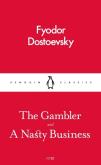
'40,000 francs, which lay before him in a heap of gold and banknotes.'
Written in twenty-six days to pay off Dostoyevsky's own roulette debts, The Gambler is a graphic psychological study of addiction, accompanied here by a brilliant short story of excruciating social embarrassment.
As Fyodor Karamazov awaits an amorous encounter, he is violently done to death. The three sons of the old debauchee are forced to confront their own guilt or complicity. Who will own to parricide? The reckless and passionate Dmitri? The corrosive intellectual Ivan? Surely not the chaste novice monk Alyosha? The search reveals the divisions which rack the brothers, yet paradoxically unite them. Around the writhings of this one dysfunctional family Dostoevsky weaves a dense network of social, psychological and philosophical relationships.
At the same time he shows - from the opening 'scandal' scene in the monastery to a personal appearance by an eccentric Devil - that his dramatic skills have lost nothing of their edge. The Karamazov Brothers, completed a few months before Dostoevsky's death in 1881, remains for many the high point of his genius as novelist and chronicler of the modern malaise.
It cast a long shadow over D. H. Lawrence, Thomas Mann, Albert Camus, and other giants of twentieth-century European literature.
In 1869 a young Russian was strangled, shot through the head and thrown into a pond. His crime? A wish to leave small group of violent revolutionaries, from which he had become alienated. Dostoevsky takes this real-life catastrophe as the subject and culmination of Devils, a title that refers the young radicals themselves and also to the materialistic ideas that possessed the minds of many thinking people Russian society at the time.
The satirical portraits of the revolutionaries, with their naivety, ludicrous single-mindedness and readiness for murder and destruction, might seem exaggerated - until we consider their all-too-recognisable descendants in the real world ever since. The key figure in the novel, however, is beyond politics. Nikolay Stavrogin, another product of rationalism run wild, exercises his charisma with ruthless authority and total amorality. His unhappiness is accounted for when he confesses to a ghastly sexual crime - in a chapter long suppressed by the censor.
This prophetic account of modern morals and politics, with its fifty-odd characters, amazing events and challenging ideas, is seen by some critics as Dostoevsky's masterpiece.
Ten produkt jest zapowiedzią. Realizacja Twojego zamówienia ulegnie przez to wydłużeniu do czasu premiery tej pozycji. Czy chcesz dodać ten produkt do koszyka?